

Alexander Grabovetskiy, woodcarver, School of Woodcarving · Published 2017
What makes a Corinthian acanthus leaf different?
Quick answer: A Corinthian acanthus is the first and probably the most ancient type of the leaf I teach, and it isn't as complicated as the later ones. All its edges finish in really sharp points, there are no curls at all, and each lobe is concave inside, which is where its shadow falls.
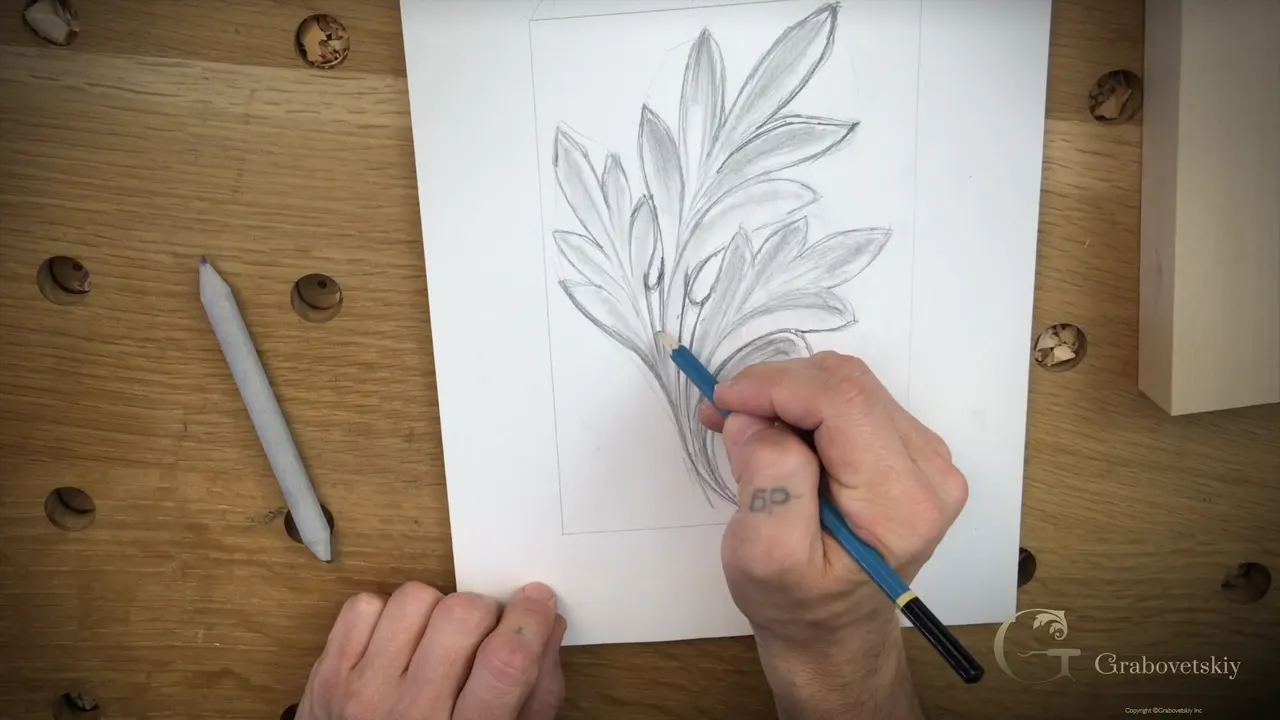
A Corinthian acanthus is the first type of the leaf I carve in my school, and the most ancient form as far as I know. Every edge on it finishes in a really sharp point. No curls. And every leaf has an incut, a concave on the inside, so the shadow falls in. That's lesson 1 of my Corinthian acanthus course.
Have you seen a carved leaf on an old cabinet door, or up on a stone column? Would you like to know where that leaf started? It started plain. In this first lesson I put a block of wood on a sheet of paper and draw the oldest acanthus form, with no gouge in my hand yet.
By the end of this page you'll know the leaf on sight, and you'll know how I lay it out on paper before the carving begins.
The short version, before we draw
- Every tip is a sharp point, and there are no curls at all.
- Each leaf is concave inside.
- A center line goes down first, then three big movements.
- Every section divides again into five separate leaves.
- Eyes sit between movements, and every pipe runs to the center line.
- The block, about 140 by 203 mm, is carved later in deep relief from one solid piece.
What makes a Corinthian acanthus leaf different?
The incut, first of all. On camera I say this type is a little different from what you probably see on furniture today, because it has an incut on the inside, like a concave inside of every leaf.
Next come the points. On a Corinthian, or Corinthic if you wish to call it that, every edge is going to be a really sharp point. It's the detail of the Corinthian type, and you always find that sharp point on it.
And no curls. On the other types we do curls, and volutes, and some really complicated stuff. The Greek leaf is where the first curls come in, and Greek acanthus lesson 1 puts the two of them side by side.
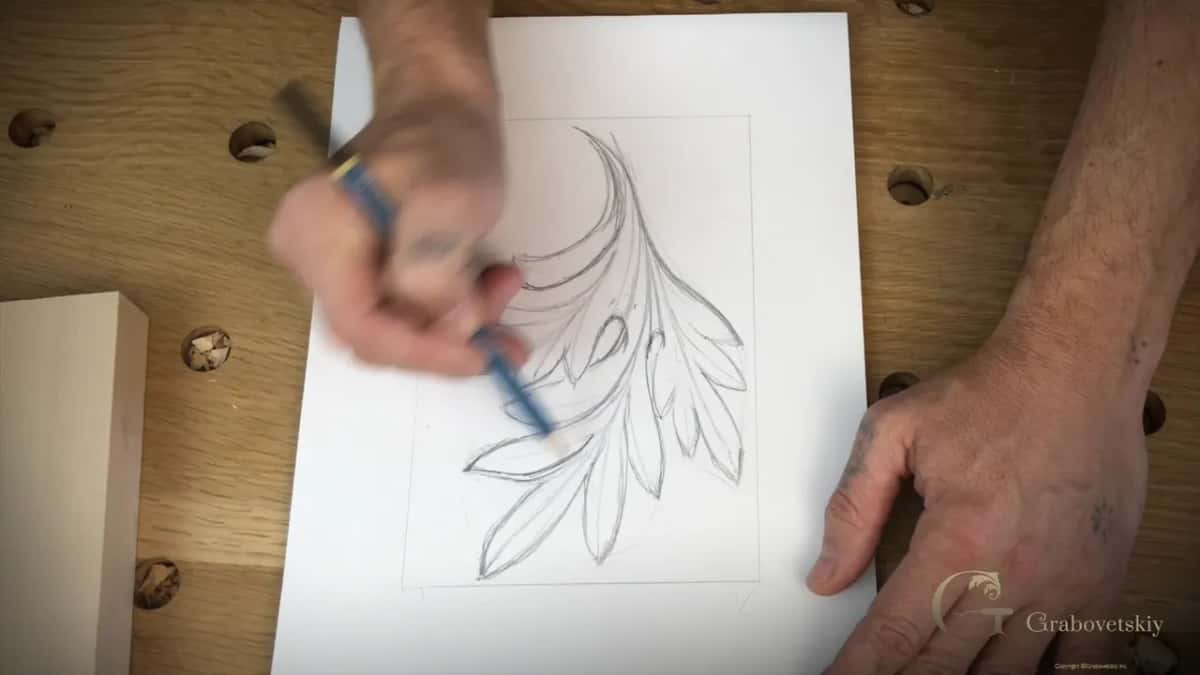
The inside matters to me because of the light. When the leaf is concave, the shadow falls on the inside, and the same applies everywhere on this design. On my drawing I shade it in, just to represent that shadow so you can understand it better.
I come back to it when the wood is set in. In Corinthian lesson 3 I say the idea is that this part of a leaf is always concave on the inside, and that it's really important to understand. I take my number 9 and establish the main concave of those leaves, while the sections between them stay higher than the rest of the inside. Working with the gouge there, one side comes out clean and the other side somewhat rough, which is absolutely fine. You can always attack from the opposite side and clean it. That raised ridge has to be really clean too, and it goes all the way to the center line.
A lesson later the hollows get finished. Corinthian lesson 4 has me carving a concave between the center line and the end edge of the leaf, from one side and then from the other, until it's really clean, so you wouldn't have any temptation to use sandpaper.
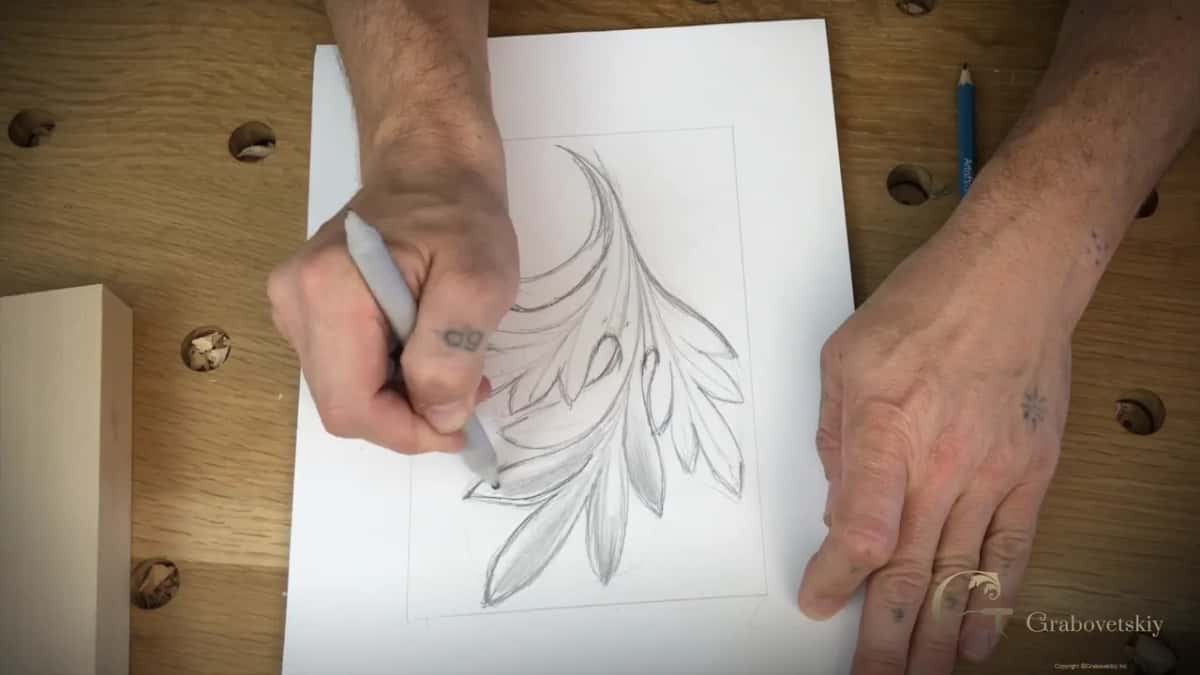
Shadow is the reason for all of it. During the undercut in lesson 5 I put it plainly: carving is actually all about the light and the shadow, especially if you're not planning to put any finish on it, any stain, or any glazing.
Where do you find the acanthus leaf?
Almost everywhere you look at carving. The acanthus leaf is the most common one in woodcarving and also in architecture. You'll find it in architectural carving, ornamental carving and furniture carving, and even in sculptures, especially ancient sculptures. It's the most common especially for the furniture guys.
I put it in almost all of my carvings. When I filmed this lesson I had just come from the Marc Adams School of Woodworking, and the deep relief piece I showed, still not done, has an acanthus leaf on the side of it.

The furniture panel you already saw has it too. You can find the acanthus right there, and even its small details are acanthus.

Rich houses have it too. In Design principles for wood carving 4 I talk about houses of the very rich, some of them guys I worked for, and I've been in those houses. The place they live is always classical. Columns, arches, and you will always find some Corinthian capital.
Where did the Corinthian order come from?
I tell it as a story, and I don't know if it's a tale or a true history. There was an architect who lived in Corinth, a town of Greek culture. He was always looking for new ideas and new designs, like probably so many architects do today.

One day, in a Corinthian cemetery, he saw the grave of a young girl. On that grave sat a basket with some cloth in it. The lady who used to feed the girl had brought it there, and nobody touched it.
An acanthus plant was right underneath the basket. It didn't grow through. It tried to weave itself around the basket and made beautiful movements all around it. When Callimachus, the architect and sculptor, saw that, he was amazed. And that was the birth of the Corinthian order, the tops of the columns, the capital itself, which we call Corinthian.

The written version is much later. The Roman writer Vitruvius told the story, and the Wikipedia page on the order dates the earliest known Corinthian capitals, found at Bassae, to around 420 BC.
The name itself means a bear's claw, the claw of an animal, and it looks like that. In Roman culture they looked at the acanthus leaf as a sign of endurance, resistance and triumph.
Is the Corinthian really the oldest acanthus?
Maybe not. I call it probably the most ancient form, but on camera I also say that might not be absolutely 100% truth. Acanthus leaves were common in different cultures. Some ancient drawings from Egypt were found from before the Corinthian acanthus, and it was decoration there too.
Greek lesson 1 opens with the finished Corinthian in my hands, and there I say the Corinthian somewhat also belongs to Greek culture, but early Greek culture. The Greek leaf we carve next is from about the same time, but still a little later.
The Roman course puts it another way. The Romans, the Greeks and the Corinthians are the first ones who used that type of acanthus, I said in Carving Roman Acanthus 1, and probably more simple forms that archaeologists found in Egypt are semi-symmetrical.
A lot of types come after it. There are two types of Greek acanthus leaf, and the first one, the most ancient which is found, is the Corinthian. Greek, Roman, Byzantine and Moroccan follow. Later the leaf traveled to European culture, and you can find Gothic, Renaissance, Belgian and French acanthus. And all of them still show one leaf, the acanthus plant.
How do the later acanthus leaves change it?
They add movement. Teaching the Byzantine course I said that after the Corinthian there was a Greek, and the Greeks got the movement, a curvature, first. The Byzantine style took it to the extreme and curved it in a three dimensional world. Carving Byzantine Acanthus Leaf 3 shows that step.
Back in Corinthian lesson 3 I call this leaf a Greek style, adapted later by the Romans, who did it exactly the same way. In the first Roman lesson I add that the Romans took most of the architectural details from Greek architects. At the beginning, before Christ, you can't even see the difference between a Greek style and a Roman style leaf. Later they added some movements, some subdivisions, and a lot more pipes.
Depth changes too. On the Greek leaf in Greek acanthus lesson 9 the carving is a little deeper than what we had on the Corinthian, so the deep undercut gives some really nice effects.
The pipes stay. In lesson 6 I say pipes are the main idea of the acanthus leaf on every design, really ancient like the Corinthian or later and more complicated, like a Renaissance era leaf. Those pipes, they must.
| Part of the leaf | What I say about it in this lesson | Time in part 1.2 |
|---|---|---|
| Center line | Established first, kept simple, but still a center line | Near 1:34 |
| Main movements | I divide the leaf into three of them | Around 1:47 |
| An eye | A special detail, almost a hole through | At 2:07 |
| A pipe | Raised and convex, concave on each side, toward center | Starting 2:35 |
| Five points | Five small leaves per section, each one sharp | From 3:39 |
| The incut | Concave inside every leaf, where shadow will fall | Close to 9:26 |
How do you draw the Corinthian leaf?
First, the block. Mine is about 5.5 inches (140 mm) by 8 inches (203 mm), and if you measure it, it's actually 5 7/16 inches (138 mm), but 5.5 will do. I lay it on paper. A pencil goes around it.

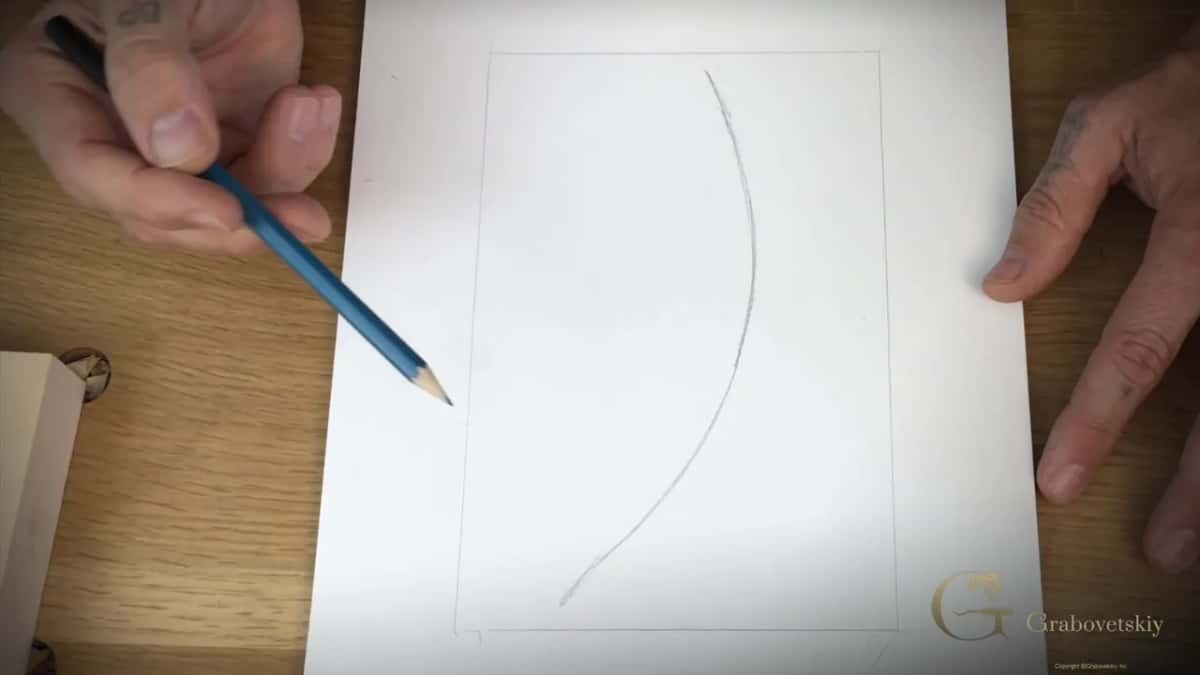
Every acanthus leaf has to have some type of movement. So first I establish the center line. I'm not going to make it really complicated, but it's still a center line. After that I divide it in three main movements. I draw the first and the second, and one more fills the space. I call it the architectural form of the acanthus leaf, should I say.

Almost every acanthus leaf has a special detail called an eye, and every one has a pipe. The eye always plays between those main movements, and in the wood it's going to be like a hole through. I place a couple of eyes. Then I even say maybe I should make one of them more to the center.

The pipe looks like a pipe. A raised part, convex, with a concave on this side and on that side. And the pipe always goes to the center line.

Then each part splits into five separate leaves. If you look at one section, it's one, two, three, four, five points, and all of them have to be sharp on this particular design. Every one of those subdivided elements goes to the center line or to the main movement. The same rule goes on the other side, and at one point I say I'm drawing just the center lines.
This one is not as complicated as what we do in the future, but it gives you an idea of how the whole idea developed. I refine the lines. I think it looks nice.
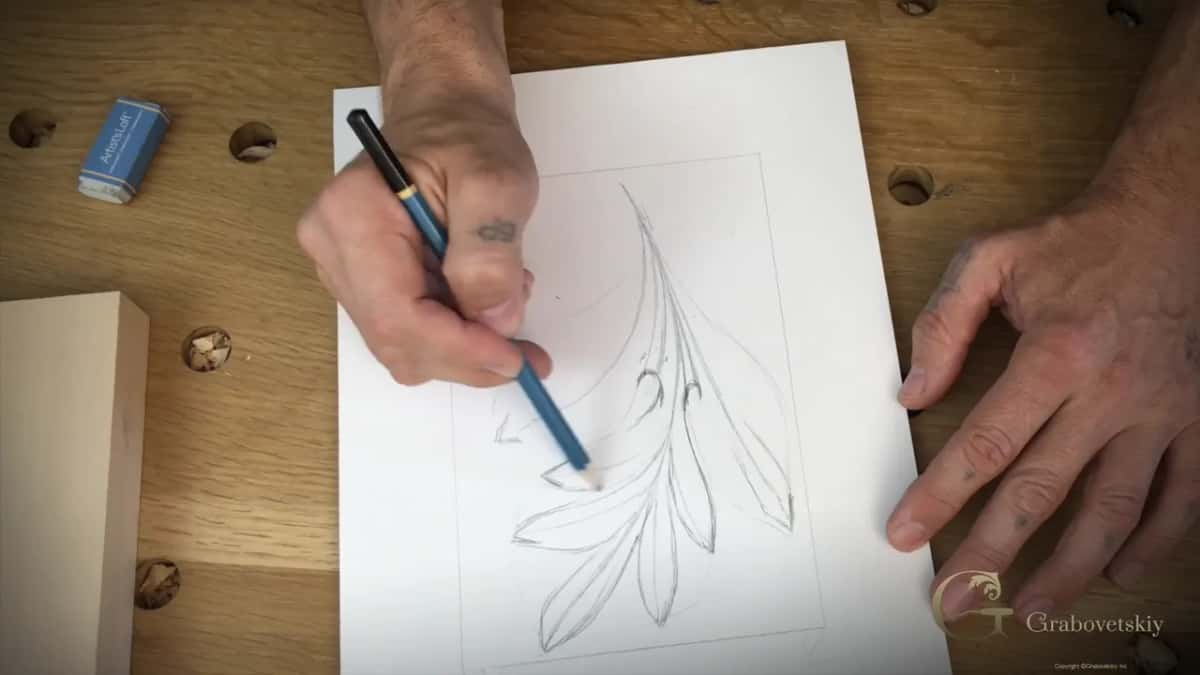
Near the end I shade the incut, so the shadow shows on paper, and I'll provide the download for you. Right at the very end I point them out once more on the drawing, a pipe, another pipe, an eye, an eye.
What will you need for this leaf?
We carve it as a deep relief, the same idea as my grape carving. That one is a really thick block of wood, and it's a solid piece. It's not glued on, and it's not done yet. We do exactly the same idea with the acanthus.
In this lesson I said the only tools would be our carving gouges and a chisel. Later, for the undercut in lesson 5, a V tool comes out too, 45 degrees or 60 degrees.

Why start with the oldest acanthus?
We're not going to carve just one, and not two or three. We work in a progression, like a historical progression of the acanthus leaf. We start with what is probably the oldest one and move on toward the more complicated ones, all the way to the Renaissance era and so on. Believe me, it's a good idea to do that. The acanthus is a beautiful leaf. And it's really ancient.
The end of the road for this one is lesson 6. Near the end I tell you to take your time and not rush anything. Then I show the leaf, with a little cleaning and detailing left, and it's pretty much done. That is Corinthian acanthus.
I really love to draw acanthus. Some of my drawings are just for the fun of it, some are for furniture with different kinds of shelves, and they're still acanthus, with all the swirls. A French acanthus is more complicated than this one.
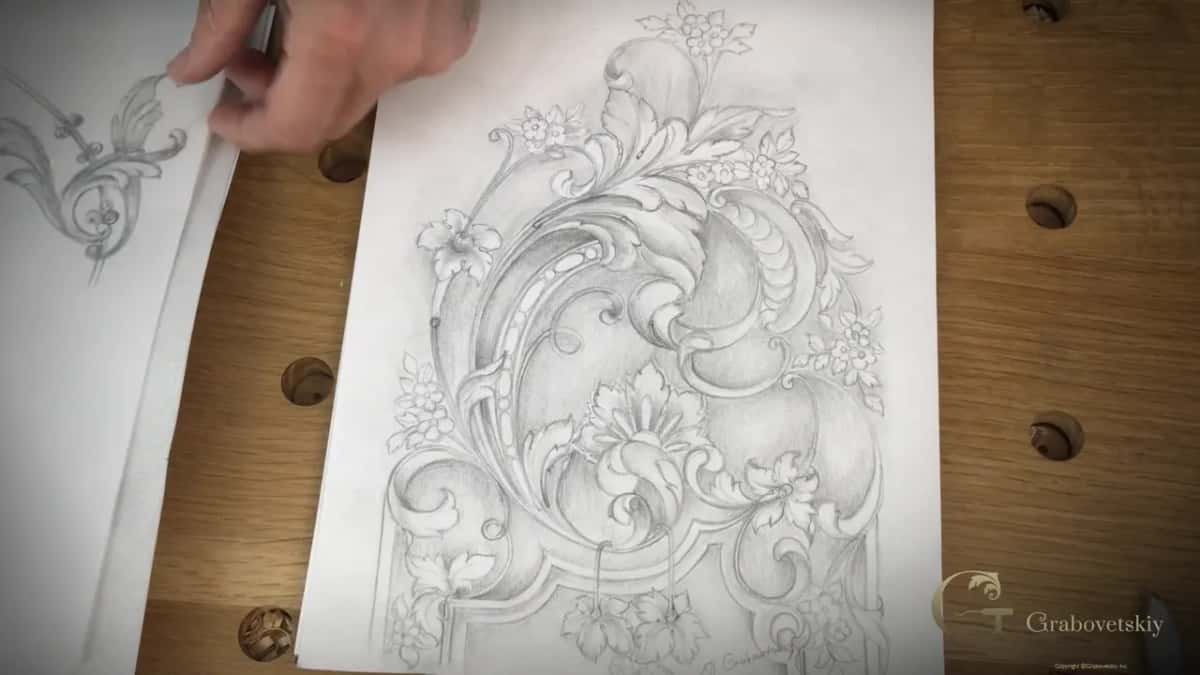

Can you hold a pencil and trace around a block? Then you can start this leaf with me and stay with it until the last sharp point. Lesson 2 takes the drawing onto the wood, and Tuition opens every lesson in the course.
How it's done
- Put the block on paper. I set my block on a sheet of paper and trace it with a pencil.
- Set the center line. Every acanthus needs some movement. The center line comes first, and I keep it simple.
- Divide it into three movements. Two of them, and then one more to fill the space.
- Place the eyes. A couple of them, always in the space between movements. Each one ends up looking like a hole through.
- Draw the pipes. Raised and convex, concave on both sides, and going to the center line.
- Split each section into five. Five sharp points per section, each heading to the center line or the main movement. The other side gets the same rule.
- Shade the incut. I shade the concave inside each leaf, just to represent that shadow.
Frequently asked questions
What does the word acanthus mean?
A bear's claw. The claw of an animal, and the leaf looks like that. In Roman culture people saw the acanthus as a sign of endurance, resistance and triumph, and every type of acanthus, the Corinthian and the French included, still shows that one plant.
Who came up with the Corinthian column capital?
Callimachus, an architect and sculptor in Corinth, according to the story I tell. An acanthus plant had grown around a basket left on a young girl's grave, and the sight amazed him. I don't know if that's a tale or true history, but the Corinthian order was born from it.
What is an eye on an acanthus leaf?
An eye is a special detail you find on almost every acanthus. On my drawing it always plays between the movements, and in the wood it will be almost a hole through. I place a couple of them on this leaf, and then I add the pipes.
What to carve next